

DIY vacuum pump
Goal
This vacuum pump I have built for vacuum bagging of composites. I have used the idea HERE, but used another, more robust, air compressor.
If you want to buy a pump, the best value for money is the ECVP425:
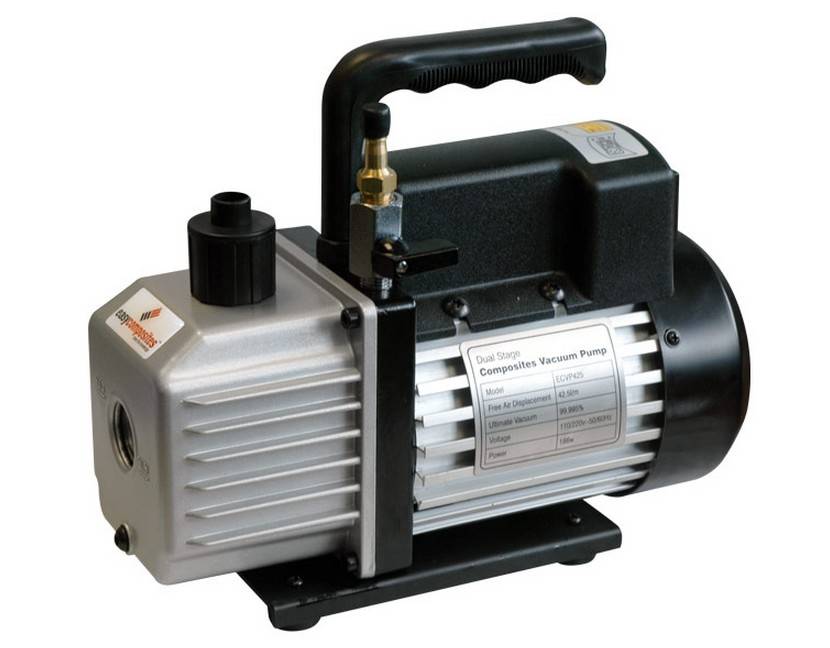 ECVP425 vacuum pump
The used 12V air compressor
Attention: some air compressors now have a piston made of plastic, this type is not usable:
 Air compressors with plastic piston
You can't know in advance whether a pump is suitable, it's a gamble. So don't spend too much money on it.
The 12V air compressor I used is sold under several names from €30:
- Ningbo Lingsheng Electric Appliance LS4028
- Mannesmann 12V compressor
- Air compressor CTO28395
- RING AUTOMOTIVE 12V Heavy Duty Air Compressor Kit
 The used 12V air compressor
DIY vacuum pump facts
- Vacuum: 0.1 bar
- Current consumption: 5A
 Vacuum pump 0.1bar
The achieved vacuum is around 0.1 bar, professional vacuum pumps realize 0.1 to 0.001 bar.
Here are the pictures of the vacuum pump. The heat sink comes from an (old) computer and provides extra cooling when the pump is wrapped in a duvet for noise reduction. This will prevent neighbors quarrel. To avoid loss of vacuum caused by small leaks, the pump can operate intermittent, with an optional timer.
 Convert a 12V air compressor into a vacuum pump
 Sound reduction by duvet
 Vacuum pump in operation
 Vacuum pump with timer
 Crank shaft and piston
Required parts
- Extension nipple from Sclaverand to Dunlop valve:

- Flange screw M3 and M3 nut.
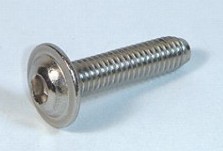 Flange screw M3
- Reinforced PVC hose, 6 mm inner diameter. Special vacuum hose are too stiff, which can harm the extension nipple.
- The vacuum pump timer is optional.
Modifications
- Remove the valve plate and cylinder head.
 Cylinder with valve
 Cylinder head
 Valve plate
- Remove the valve of the cylinder; this will be the exhaust valve.
- Seal the two holes of the cylinder with epoxy.
 Piston holes sealed
- Remove the valve of the valve plate; this will be the intake valve.
- Drill a 6mm hole in the valve plate for the exhaust valve. Drill a 2mm shallow hole for the valve lip:
 Drill two holes
- Flatten the valve plate with sandpaper (on the other side of the rubber ring).
- Glue the extension nipple with epoxy into the intake valve hole (on the other side of the rubber ring).
 Exhaust valve and glued nipple
- File the M3 screw head down to 0.5mm thickness, see the image.
- Mount both valves with the M3 screw. The intake valve comes at the original place again. The exhaust valve comes on the other side.
 All parts
 Intake valve
 Intake valve
- The screw head must sometimes be bent, to let fit the intake valve precisely to the rubber ring. The rubber ring may not leak and must keep the vacuum constant.
 Bented screw head
 The valve fits to the rubber ring
- Put the valve plate and cylinder head back. Note: The valve plate is now reversed.
- Mount a heat sink and use thermal grease.
 Heat sink
Soundproof vacuum pump enclosure
Because I don't want to have a war with my neighbours, I made a soundproof vacuum pump enclosure. Use the pump not longer than some minutes because the pump is not cooled anymore.
Note that a vacuum pump generates a significant amount of heat and causes a serious risk on fire. So don't leave it unattended to prevent that your house will be burned down.
 Soundproof vacuum pump enclosure
DIY vacuum desoldering iron
Cheap desoldering tools like desoldering pumps and rubber bulb desoldering irons work unsatisfactory. However, good desoldering stations are quite expensive. But if we have a vacuum pump, we can change a simple and cheap rubber bulb desoldering iron into a professional vacuum desoldering iron:
 Rubber bulb desoldering iron
 DIY vacuum desoldering iron
A vacuum filter is used to collect the solder tin. The vacuum pump is controlled by a footswitch.
My desoldering iron has a power of just 30W, each time after desoldering he has to warm up again, this is inconvenient. So more power is recommendable.
Avoid vibration during resin degasification
At resin degasification, the work table can vibrate due to the vacuum pump. This causes the resin splashes around in the vacuum chamber. A vibrating vacuum pump should be kept away from the work table.
Vacuum and the human being
- A human being may survive a period of more than 1 minute in high vacuum, and will not explode!
- The maximum vacuum that can be sucked by mouth is about 0.3bar.